New Publication: Cultural Robotics — Diversified Sustainable Practices
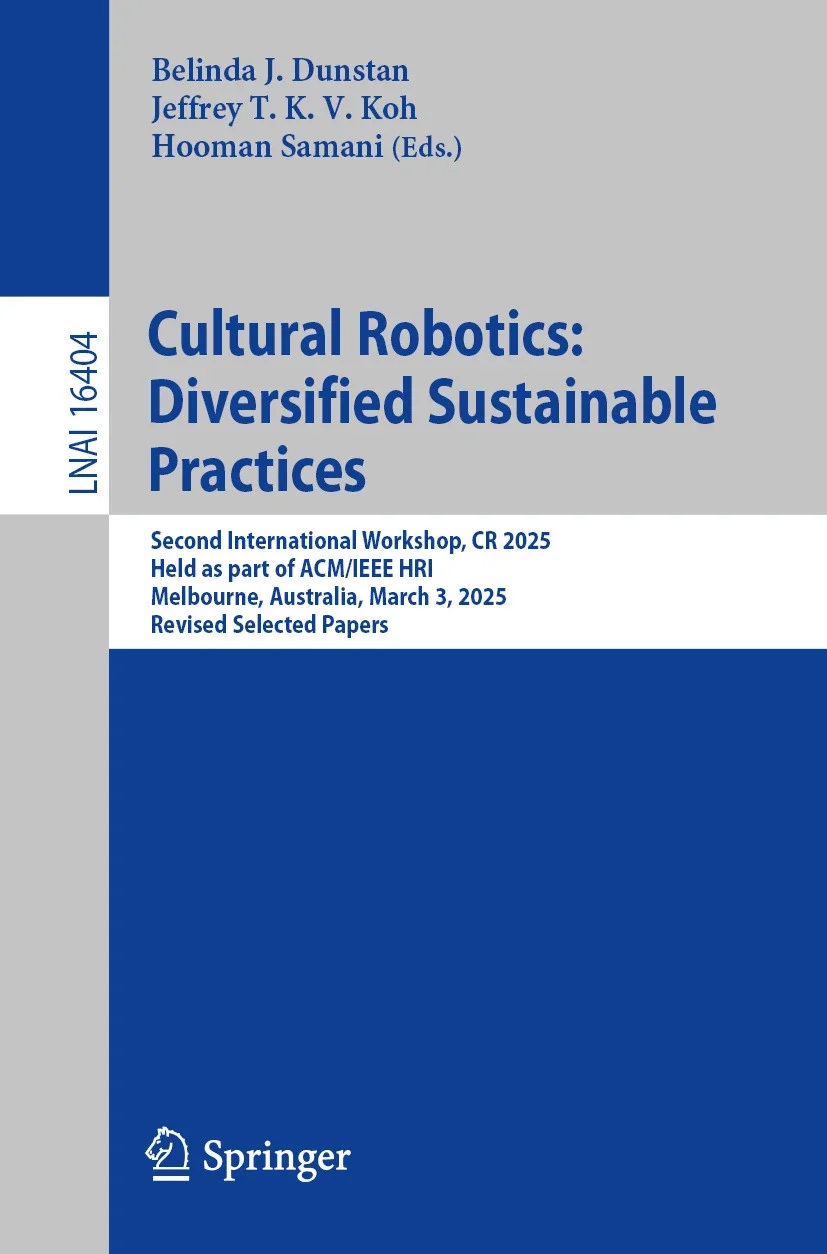
Proceedings from the 2nd International Workshop on Cultural Robotics at ACM/IEEE HRI 2025, Melbourne
Published in Springer Lecture Notes in Artificial Intelligence (LNAI 16404)
We are delighted to announce the publication of Cultural Robotics: Diversified Sustainable Practices, the latest volume in the Cultural Robotics series, published by Springer as part of the Lecture Notes in Artificial Intelligence (LNAI 16404). Edited by Belinda J. Dunstan (UNSW), Jeffrey T.K.V. Koh (Singapore Institute of Technology), and Hooman Samani (University of the Arts London), this volume collects revised and expanded papers from the 2nd International Workshop on Cultural Robotics, held on 3 March 2025 as part of the ACM/IEEE International Conference on Human–Robot Interaction in Melbourne, Australia.
Why Cultural Robotics?
Cultural robotics starts from an essential premise: there is no social robotics without culture. Every interaction between a person and a robot is shaped by language, gesture, heritage, and values. Treating robots as universal, context-free technologies ignores the way communities interpret, resist, and reimagine them. This field insists that robots are cultural actors—they embody meaning, tell stories, and mediate relationships—and that designing for sustainability means attending to material, emotional, and cultural longevity alike.
This third volume builds on the foundations laid by the first Cultural Robotics proceedings (IEEE RO-MAN, Kobe, 2015) and the second volume, Social Robots and Their Emergent Cultural Ecologies (Springer, 2023). Where previous volumes explored how robots maintain, participate in, and produce culture, this edition turns attention to sustainability and the circular economy—asking how diverse cultural practices can inform the responsible design, reuse, and retirement of social robots.
The Workshop
The workshop drew over 40 researchers from 14 countries—including Australia, Austria, Bangladesh, China, Denmark, Finland, Germany, Japan, Rwanda, Singapore, South Africa, Spain, the UK, and the USA—spanning engineering, design, art, education, and industry. Contributors presented 15 poster submissions in a gallery-walk format with lightning talks and critical discussion. The day also featured a keynote on Sustainability Principles for Robotics Design and a hands-on session prototyping robot expression through movement, posture, and puppetry using found materials.
What’s Inside
The 15 chapters are organised into three thematic sections that bridge technological innovation with cultural and artistic relevance.
Part I — Cultural Sensing and Sensitivities
This section grounds robotic systems in specific cultural contexts, going beyond sight and sound to include sensory, narrative, and aesthetic dimensions. A framing chapter by Dunstan, Koh, and Samani surveys the field’s 12-year development and introduces circular-economy principles for cultural robotics. The remaining chapters explore olfaction-based cultural learning experiences in museums (Cao, Lai & Chung); culturally sensitive social robotics for Africa with case studies in Rwanda and South Africa (Akinade et al.); an AI-powered museum guide robot fine-tuned on Bengali dialects for preserving Bangladesh’s multilayered heritage (Ahmed et al.); a participatory framework and design toolkit for culturally informed robotic movement (Lalioti et al.); a storytelling robot named ODI designed for cultural preservation through mythic narratives (Ireland & Cefai); and origami-inspired morphologies that use visual affordances to communicate robot movement intentions (Johansen & Merritt).
Part II — Art + Robotics
This section treats robots not simply as tools but as collaborators, performers, and expressive media. Gollob explores strategies for reimagining industrial robot arms as cultural agents through artistic practice. Turnbull Tillman and Li investigate the lab-as-gallery/gallery-as-lab model through a hair-combing robot that probes intimacy and the body–machine relationship. The RAPP Lab retrospective (Jayasuriya, Wijesundara & Herath) documents a decade of transdisciplinary performance research including collaborations with Stelarc. Cubero and Jochum introduce EMCAR, a no-code tool that lets artists program robot motion through drawing and puppetry. And Nadeem and Dunstan present a system that translates facial expressions into affective robotic illustrations—using the expressive geometry of the face to drive kinetic output.
Part III — Cultural Futures
This final section engages with the societal implications and ethical challenges of advanced robotics and AI. Patel and Iandoli confront the risks of cognitive offloading in mainstream AI by proposing ERWIN, a voice-only sparring partner designed to sustain human critical thinking. Xue et al. introduce a participatory framework for AI-enabled AgeTech co-created with elderly populations in Singapore and Finland, centred on contextual intelligence. Merritt et al. address material sustainability head-on with CopyCut, a vision-based digital fabrication tool that turns material offcuts into soft robot components. And Aue and Koh close the volume by advancing a regenerative design framework that positions robots as agents of regeneration—pursuing multi-life-cycle design, circular economy strategies, and cultural situatedness.
Full Chapter Listing
Part I — Cultural Sensing and Sensitivities
Diversified Sustainable Practices in Cultural Robotics — Belinda J. Dunstan, Jeffrey T.K.V. Koh, and Hooman Samani
Olfaction Experience in Cultural Robotics: Case Studies for Cultural Learning Futures — Yan Yan Cao, Mei Kei Lai, and Siu-Wing Chung
Culturally Sensitive Social Robotics for Africa — A. Akinade, D. Barros, E. Birhan, M. Danso, Y. Haile, I. Jimoh, C. Osano, P. Ranchod, M. Richard, B. Rosman, B. Shimelis Girma, T. Taye Tefferi, and D. Vernon
A Participatory Approach in Robotics with Artificial Intelligence to Preserving Bangladesh’s Multilayered Cultural Heritage in Museums — Nizar Ahmed, Nusrat Jahan Shawon, Mahmudul Hasan, and Mohammad Shidujaman
Designing Robotic Movement with Culture in Mind — Vali Lalioti, Shota Kiuchi, Alisa Koegel, Cheng Chang, Hooman Samani, and Miles Pennington
ODI: A Storytelling Robot Designed for Cultural Preservation — Amena Ireland and Ruben Cefai
Unfolding Robot Morphologies: Expressive Origami for Conveying Movement Intentions — Stine S. Johansen and Timothy Merritt
Part II — Art + Robotics
Xenomorphosic Encounters: Strategies for Reimagining Industrial Robots as Cultural Agents — Emanuel Gollob
On Creative Research: The Lab as Gallery / the Gallery as Lab — Deborah Turnbull Tillman and Zoe Qi-jing Li
Robots, Art, People, and Performance (RAPP) Lab — A Retrospective — Maleen Jayasuriya, Piumi Wijesundara, and Damith Herath
EMCAR: Embodied Controller for Animating Robots — Carlos Gomez Cubero and Elizabeth Jochum
Emotional Lines: Translating Facial Expressions into Affective Robotic Illustrations Through a Geometric Feature-Based Method — Hareem Nadeem and Belinda J. Dunstan
Part III — Cultural Futures
Who is Prompting Whom? Designing a Voice-Only Anthropomorphic Sparring Partner for Sustainable Dialogic Reasoning — Nadya Shaznay Patel and Luca Iandoli
Contextual Intelligence: Co-creating AI-Enabled AgeTech for Elderly Populations in Singapore and Finland — Lishan Agnes Xue, Frank Guan, Peck Hoon Ong, Toini Palo, Anna Kaipainen, and Ari-Pekka Åker
CopyCut Robots: Analog and Digital Workflows for Sustainable Soft Robot Design — Timothy Merritt, Stine S. Johansen, Jakob Andersen, Jesper Ravn-Nielsen, and Thomas Egon Kaergaard
Towards Robots as Agents of Regeneration — Karin Aue and Jeffrey T.K.V. Koh
Access the Publication
The volume is available from Springer: https://doi.org/10.1007/978-3-032-15501-6
We extend our gratitude to the international cultural robotics community whose contributions continue to expand what is possible at the intersection of robotics, culture, art, and sustainability. We look forward to the conversations this volume will inspire.
— Belinda J. Dunstan, Jeffrey T.K.V. Koh, and Hooman Samani
Postdisciplinary Robotics: Cultural Robotics as aSite for the Future of Sociocultural Machines
In anticipation for ICSR 2026, a manuscript on the future of Cultural Robotics is being prepared for consideration. Here’s the working abstract:
Robotics is a hybrid field that necessarily integrates a multiplicity of disciplinary knowledges, including psychology, design, and ethics. As social-cultural agents, robots are embedded within human values, rituals, and social imaginaries. This paper explores the relationship between robots and culture and proposes a postdisciplinary approach to robotics as a site for inclusive and pluriversal research and practice. This approach is not a rejection of the traditional scholarly and academic disciplinary boundary of robotics, but a renewal: a call to reimagine robots as an ecology of knowledge capable of responding to the complex realities of human and planetary futures.
Google’s NotebookLM provides a summary, animated into a video using Adobe Podcast:
The Proceedings for the 2nd International Workshop on Cultural Robotics @ HRI’25 Has Been Sent to the Publishers!
After many delays, several rounds of editing, rewrites, formatting, and all the other challenges that come with bringing together high-quality manuscripts by Cultural Robotics researchers from across the globe, the CultureBots editorial team is proud to announce that the final, camera-ready version of the Proceedings for the 2nd International Workshop on Cultural Robotics @ HRI ’25 has been sent to Springer for publishing!
We are especially proud of this edition, as it took a full decade to run the second workshop since our first one at IEEE Ro-Man in 2015. And while we have published an edited volume since then, it’s been a long time since researchers in the field have had a chance to come together in-person. The HRI’25 workshop was an important reminder that while we are able to work across vast distances, crossing multiple timezones and socio-geographic boundaries, there’s nothing like meeting face-to-face.
The edited volume is divided into three themes. These are: I. Cultural Sensing and Sensitivities, II. Art + Robotics, and III. Cultural Futures. We are proud and grateful to have the Forward of our collected volume penned by Prof. Müge Belek Fialho Teixeira from Queensland University of Technology, where she reflects on the concept of Culture in relation to the chapters in the book. We are also eternally grateful to the Cultural Robotics Community for entrusting us with their research yet again, so that we could bring this collected volume to publication.
Last but not least, the discourse around Cultural Robotics will continue in 2026 at the 18th Annual International Conference on Social Robotics (ICSR 2026), where the field of Cultural Robotics will have its own special section! Be sure to check out the call for contributions, and we look forward to seeing you in London in 2026!
Cultural Robotics Gets its Own Special Track at the 18th International Conference on Social Robotics (ICSR 2026)
Cultural Robotics continues to grow as an interdisciplinary field of research and practice. In next year’s edition of the 18th International Conference on Social Robotics (ICSR 2026), Cultural Robotics will have it’s own, special track!
Hooman Samani, along with Saina Akhond, will be General Chairs of the conference. The conference will run from the 1st to the 4th of July, 2026. Co-chairing the Cultural Robotics track are Jeffrey Koh and Belinda Dunstan, who have edited several books (1, 2, 3) and authored numerous peer-reviewed articles on Cultural Robotics, respectively.
As we approach the July 2026 ICSR opening, the CultureBots team will develop the scope and call for the special track. Some considerations include if we should publish in the proceedings or develop a separate, edited volume. Keep an eye on www.culturebots.org for our call for contributions, bookmark the ICSR website, and look forward to continuing the conversation on robotics and its role as cultural agents in London 2026!
HRI'25 Update
Dear Cultural Robotics Community,
HRI'25 Melbourne is in full swing! The 2nd International Workshop on Cultural Robotics ran on day 1 and it was a success, with a very nice turnout of participants and contributors. Belinda Dunstan led us as we got our hands dirty and prototyped robot expression through movement and posture using found materials and puppetry techniques. There was also a lot of lively dialog around the inspired poster submissions. Bringing an art-school-vibe to HRI
Dear Cultural Robotics Community,
HRI'25 Melbourne is in full swing! The 2nd International Workshop on Cultural Robotics ran on day 1 and it was a success, with a very nice turnout of participants and contributors. Belinda Dunstan led us as we got our hands dirty and prototyped robot expression through movement and posture using found materials and puppetry techniques. There was also a lot of lively dialog around the inspired poster submissions. Bringing an art-school-vibe to HRI, we employed a 'gallery walk' critique format for the poster presentations. The diversity of projects and perspectives really pushed us to reflect on the values, principles, methods and practices that might emerge to further help us define 'Cultural Robotics'.
On day 2 there was an impromptu meetup of researchers and practitioners interested in the field(?). Meeting outside under the Melbourne sun evoked a sense of new beginnings. Discussions revolved around the platforms we might establish to facilitate more interaction within and beyond the community, milestones towards a thematic track at ICSR 2026 (Link to ICSR 2025) along with the potential for a special issue of IJSR. And of course, there was a lot of lively discussion on the definition of Cultural Robotics. Do we even attempt to define a position? Or do we rather nurture and facilitate space for a generative definition to emerge?
In an attempt to provide a means to loosely stay connected, the group agreed on LinkedIn as a bootstrap platform. A group has been created and we encourage you to join! We welcome your ideas on extending and hopefully, decentralising the community to better facilitate emergent and divergent directions for Cultural Robotics. If you want to be a more active collaborator and/or custodian for our growing community, please reach out... or don't and do your own thing! We're not the kultbots police. But we are here for you in whatever capacity.
And finally, for authors of the upcoming workshop proceedings, please keep an eye on the CultureBots website. The latest author instructions can be found there. We will also follow up with a separate email with more details soon. Thank you all, very much, for making HRI’25 Cultural Robotics: Diversified Sustainable Practices a success. We are excited to continue the journey together towards the publication and beyond.

Warmly,
The CultureBots Team